
Top 5 Sealants for Interior Decoration: Ranking and Selection Reasons
Cover: SANZON sealant and gap-filling product packaging used for interior decoration supply.
Interior decoration is not one sealing job, it is four or five different ones. A door frame needs a flexible joint filler. A skirting line needs a product that can be overpainted. A tiled floor needs a grout that resists staining and cleaning chemicals. A shower corner needs a joint that does not turn black. Buying a single general purpose tube for all of them is the most common mistake in home improvement procurement.
This ranking sets out five products from the SANZON range in order of how broadly they fit interior decoration work: SANZON MS (MS sealant / silane-modified polymer sealant), SANZON GA (polyurea tile grout), SANZON GM (epoxy tile grout), SANZON AS (acrylic sealant), and SANZON GP (general purpose silicone sealant). Every entry gives the inclusion reason, the documented specification behind it, and the situation where a different grade is the better choice.
Why interior joint selection goes wrong so often
Three variables decide whether an interior joint still looks correct two years later: whether the substrate is porous or non-porous, whether the joint will move, and whether the surface will be painted or wiped clean daily.
- Paint versus no paint. Traditional silicone sealants are generally not designed to be painted after curing. If a joint runs along a wall that will receive emulsion, an unpaintable bead reads as a glossy stripe that no decorator can hide.
- Wet area versus dry area. A joint in a shower or a kitchen backsplash is a moisture and hygiene problem, not only a gap-filling problem, so the specification changes from adhesion to sanitation and stain resistance.
- Odor and cure chemistry. Acid-cure silicone releases a vinegar-like acetic acid odor during curing. In an occupied apartment or a hotel refurbishment, that is a schedule problem, not just a comfort problem.
Ranking these products by the question of which one is best, without naming the joint, is therefore not useful. The ranking below is a fit ranking: each product is scored on how many common interior decoration situations it covers well.
Industry background: why indoor sealing specifications are tightening
The global silicone sealants market was valued at USD 4.5 billion in 2025, with Asia Pacific accounting for a revenue share of 52.1% in the same year (Grand View Research). Room-temperature-vulcanizing (RTV) products held a 64.8% revenue share by technology in 2025, and the construction segment held the largest end-use share at 60.7% (Grand View Research). Two structural signals sit behind those figures.
- Standards are still the reference point. ASTM C920, the primary performance standard for elastomeric joint sealants used in building construction, was reapproved in November 2024 as ASTM C920-18(2024), so specifiers work from a maintained document rather than a legacy one (ASTM).
- Chemical-level rules keep moving. EU Regulation 2024/1328 restricts cyclic silicones D4, D5 and D6, including an industrial-use threshold of 0.1%, and bans them in leave-on cosmetics from June 2027 (EUR-Lex). The direction of travel is toward tighter control of indoor chemical profiles.
Trade data shows the same category moving quickly between markets: China exports of silicone under HS 321410 to India grew by USD 16.7 million between 2024 and 2025 (OEC). For interior decoration buyers, the practical consequence is that product-level documentation, not only the name printed on a cartridge, is what separates suppliers able to support a specification from those that cannot.
How this ranking was built
Six criteria were applied to the manufacturer's published product data:
- Indoor air and odor profile (cure chemistry, VOC statement, formaldehyde statement).
- Paintability of the cured joint.
- Substrate fit, covering porous and non-porous surfaces.
- Wet-area and hygiene performance.
- Service temperature range and stated durability.
- Application and supply practicality (packaging format, shelf life, order quantity, lead time).
Only products with documented specifications were included. No independent laboratory comparison was carried out for this article, and the order reflects fit for interior decoration rather than a claim that one chemistry is universally superior. All five products are manufactured by Shandong Sanzeng New Materials Co., Ltd., an integrated sealant supplier based in Linqu County, Weifang City, Shandong Province, China, that produces sealant products, sealant packaging, and sealant filling equipment, and exports to more than 30 countries and regions. Product names below are used exactly as they appear in the company product documentation.
The top 5 interior decoration sealants and grouts, ranked
1. SANZON MS MS sealant / silane-modified polymer sealant
Ranked first because it is the only product in this group that combines a neutral low-odor cure, paintability, and a wide service temperature range in one 300 ml cartridge.
- Chemistry: modified silane polymer (MS polymer), one-component, neutral cure at room temperature.
- Formaldehyde-free formulation; MS grades are isocyanate-free and solvent-free.
- Painting-compatible after curing, so the joint can be coated to match the wall.
- High-tack performance; service range from −50 °C to +150 °C.
- Colors: transparent / white / black / grey / others; 300 ml × 24 pcs per carton; 12-month shelf life.
Selection reason: it removes the two most frequent complaints about interior silicone work, a smell during cure and a glossy bead under paint, while keeping a wide temperature tolerance for joints that see seasonal movement.
Where it is not the answer: structural curtain wall joints and fire-rated joints belong to separate product families, namely SANZON CS structural silicone sealant and SANZON FS firestop silicone sealant in the same range.
2. SANZON GA polyurea tile grout / tile gap filler
Ranked second and the first choice wherever a tile joint stays wet. It is a two-component aspartic-ester polyurea gap filler with silver-ion antibacterial function.
- Cure: two-component A+B, room-temperature cure.
- VOC: ultra-low; formaldehyde-free and odorless.
- Service range: −50 °C to +100 °C; stated weather life of more than 30 years.
- Packaging: A+B 400 ml × 20 pcs per carton; store at +5 °C to 27 °C.
Selection reason: hygiene and longevity in one product. Silver-ion antibacterial function addresses the sanitation concern in bathrooms and kitchens, while the ultra-low VOC, formaldehyde-free and odorless formulation keeps the joint acceptable in occupied interiors.
Where it is not the answer: on substrates that are not ceramic or stone, or where a flexible movement joint rather than a rigid grout line is required, an MS or silicone grade is the correct specification.
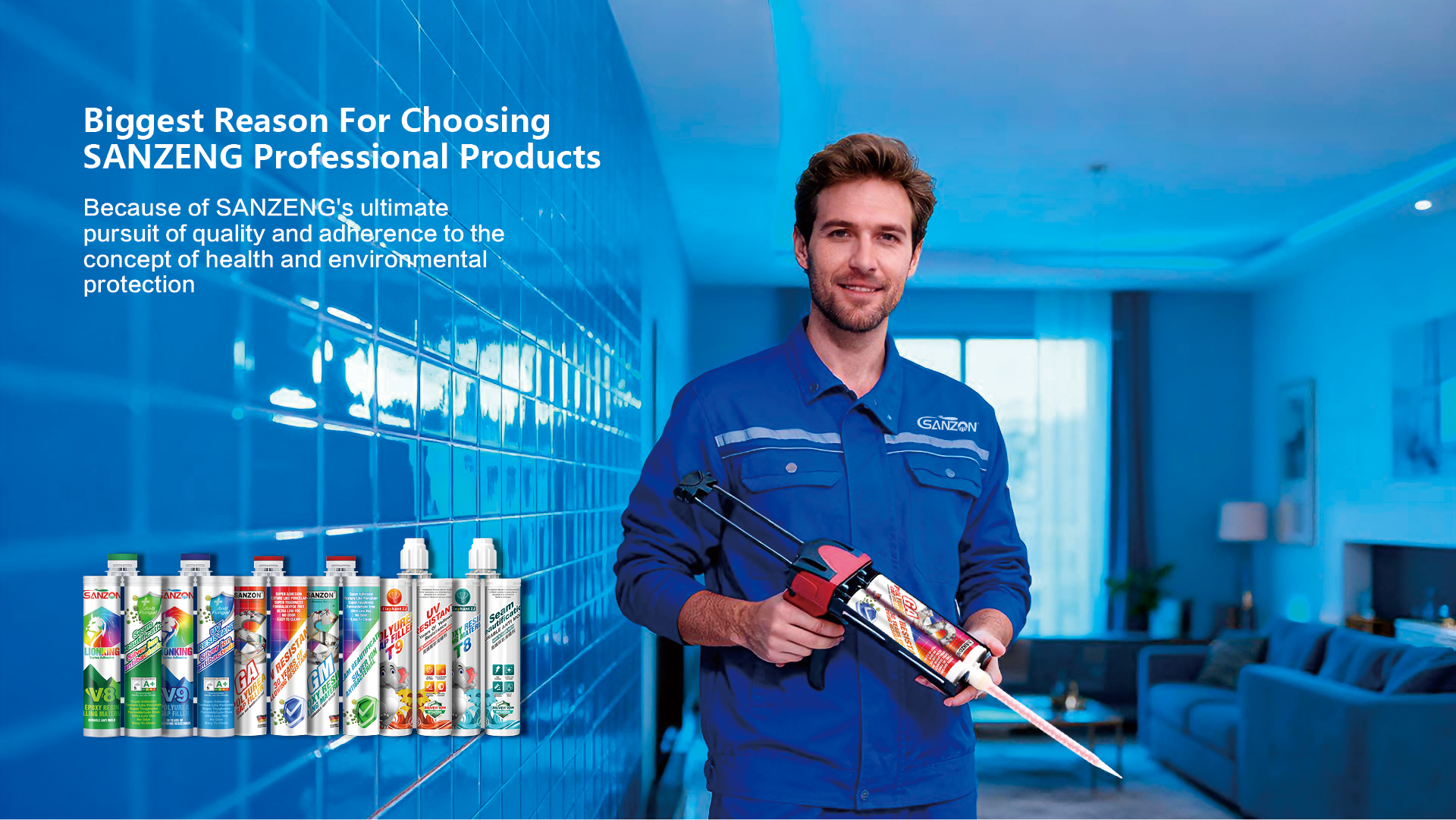
SANZON tile grout family: epoxy and polyurea gap fillers for interior tile seams.
3. SANZON GM epoxy tile grout / tile gap filler
Ranked third because it targets the visible design layer of a tiled interior. It is a two-component epoxy resin gap filler of the seam beautification type.
- Cure: two-component A+B, room-temperature cure; epoxy resin plus curing agent.
- Solvent-free with ultra-low VOC; odorless and non-toxic.
- Available in a rich color series for seam matching.
- Packaging: A+B 400 ml × 20 pcs per carton; store at +5 °C to 27 °C.
Selection reason: where the grout line is part of the design intent rather than a technical detail, color control matters more than anything else, and the solvent-free, odorless formulation keeps it usable in finished living areas.
Where it is not the answer: for joints exposed to frequent standing water and heavy cleaning, the silver-ion antibacterial polyurea grade is the more targeted choice.
4. SANZON AS acrylic sealant
Ranked fourth, and the reference product for any interior joint that will be painted. It is a single-component paintable acrylic sealant of universal decoration type.
- Chemistry: acrylic polymer, one-component, neutral cure at room temperature.
- Paintable, and specified as low VOC and low odor.
- Service range: −10 °C to +80 °C.
- Colors: transparent / white / black / grey / others; 300 ml × 24 pcs per carton; 12-month shelf life.
Selection reason: paintability plus a low odor profile. Trim gaps, architrave joints and plasterboard seams that will be coated with emulsion are exactly the applications where a conventional silicone bead creates a permanent visible stripe.
Where it is not the answer: the service range is the narrowest in this ranking at −10 °C to +80 °C, so projects with high service temperatures or continuous water exposure should move to an MS, polyurea or silicone grade.
5. SANZON GP general purpose silicone sealant
Ranked fifth. It remains the entry-level general sealing product for interior decoration, described in the product documentation as an acid-cure general purpose silicone sealant for interior decoration.
- Cure: acidic at room temperature; service range −50 °C to +120 °C.
- Colors: transparent / white / black / grey / others; 300 ml × 24 pcs per carton; 12-month shelf life.
- Neutral-cure alternative in the same family: SANZON GP-N neutral-cure multi-purpose silicone sealant, service range −50 °C to +150 °C.
Selection reason: cost-effective general sealing of glass, ceramics and other non-sensitive substrates where the joint will not be painted and the acetic odor during cure is acceptable on site.
Where it is not the answer: two limits apply. Acid-cure silicone releases a vinegar-like odor while curing, and traditional silicone sealants are generally not intended to be painted directly after curing. Where either point is a constraint, specify SANZON GP-N, SANZON AS or SANZON MS instead.
How to specify an interior decoration sealant in six steps
- Classify the joint. A grout line between tiles, a movement joint between dissimilar materials, or a trim seam that will be covered by paint. Grout lines point to SANZON GM or SANZON GA; movement and trim joints point to MS, acrylic or silicone grades.
- Check the substrate. Glass and ceramics suit silicone; painted plaster and plasterboard suit acrylic; multi-material joints favor MS polymer, which is formulated for high tack.
- Decide whether the joint will be painted. If yes, start from SANZON AS or SANZON MS, both of which are specified for painting.
- Assess the wet area. Showers, kitchen backsplashes and floor tile joints point to SANZON GA (silver-ion antibacterial, ultra-low VOC, formaldehyde-free and odorless) or SANZON GM (solvent-free, ultra-low VOC, odorless and non-toxic), with SANZON KB sanitary anti-mold silicone sealant at basin and sink edges.
- Confirm service range and storage. MS sealant covers −50 °C to +150 °C, GP covers −50 °C to +120 °C, AS covers −10 °C to +80 °C, and GA covers −50 °C to +100 °C. Both grouts are stored at +5 °C to 27 °C, and sealant and grout cartridges carry a stated 12-month shelf life.
- Verify the supply chain. Ask for certificate numbers, then confirm order quantity, lead time, OEM capability and packaging format: 300 ml × 24 pcs per carton for sealants, A+B 400 ml × 20 pcs per carton for the two-component grouts.
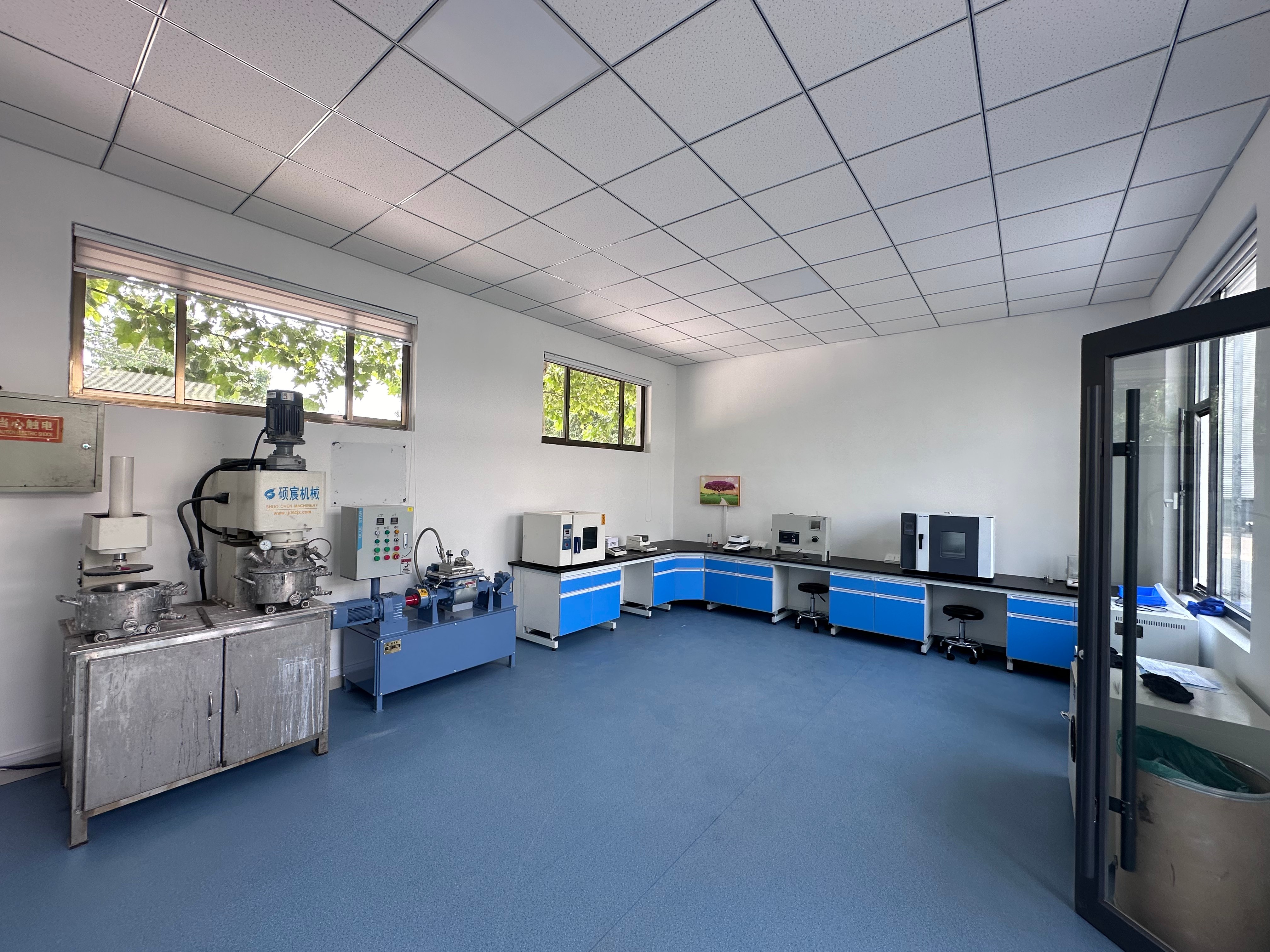
Selection and compatibility checks on the sealant line before a product is recommended for a project.
Where each product fits in a real interior project
- Occupied apartment repaint. SANZON AS acrylic sealant for gaps between skirting, architraves and plaster that will be overpainted; SANZON MS where the same joint also moves or needs high tack.
- Kitchen backsplash and bathroom tile. SANZON GA polyurea tile grout for joints that stay wet, supported by its silver-ion antibacterial function and stated weather life of more than 30 years; SANZON KB sanitary anti-mold silicone sealant at basin, hob and sink edges.
- Living area floors and feature walls. SANZON GM epoxy tile grout where the seam color is part of the design, using its rich color series and solvent-free formulation.
- Window and door reveals. SANZON GP general purpose silicone sealant for interior sealing of glass and ceramics, or SANZON GP-N neutral-cure multi-purpose silicone sealant where a neutral, lower-odor cure on a more sensitive substrate is required.
- Bonding decorative panels without nails. Beyond the five ranked products, SANZON GS and SANZON GK no-nail construction adhesives are formaldehyde-free and benzene-free, with an 18-month shelf life, for wall panels and decorative trim.
Comparison table: the five products side by side
| Rank | Product and model | Chemistry and cure | Documented interior-relevant features | Best-fit interior use |
|---|---|---|---|---|
| 1 | SANZON MS — MS sealant / silane-modified polymer sealant | Modified silane polymer, one-component, neutral cure at room temperature | Formaldehyde-free; isocyanate-free and solvent-free; painting-compatible after curing; high tack; −50 °C to +150 °C; 300 ml × 24 pcs per carton; 12-month shelf life | Painted trim, skirting, door and window reveals, multi-substrate joints |
| 2 | SANZON GA — polyurea tile grout / tile gap filler | Two-component aspartic-ester polyurea, A+B room-temperature cure | Silver-ion antibacterial; ultra-low VOC; formaldehyde-free and odorless; −50 °C to +100 °C; weather life more than 30 years; A+B 400 ml × 20 pcs per carton; store at +5 °C to 27 °C | Kitchen, bathroom and balcony tile joints; wet areas |
| 3 | SANZON GM — epoxy tile grout / tile gap filler | Two-component epoxy resin plus curing agent, A+B room-temperature cure | Solvent-free; ultra-low VOC; odorless and non-toxic; seam beautification type with a rich color series; A+B 400 ml × 20 pcs per carton; store at +5 °C to 27 °C | Color-matched living-area tile seams and decorative grout lines |
| 4 | SANZON AS — acrylic sealant | Acrylic polymer, one-component, neutral cure at room temperature | Paintable; low VOC and low odor; universal decoration type; −10 °C to +80 °C; 300 ml × 24 pcs per carton; 12-month shelf life | Interior trim, plaster and painted surfaces; joints that will be overpainted |
| 5 | SANZON GP — general purpose silicone sealant | Silicone polymer, one-component, acid (acetoxy) cure at room temperature | Acid-cure general purpose grade described for interior decoration; −50 °C to +120 °C; 300 ml × 24 pcs per carton; 12-month shelf life | General interior sealing of glass and ceramics where no overpainting is required |
Alternative inside the same family: SANZON GP-N neutral-cure multi-purpose silicone sealant covers −50 °C to +150 °C with a neutral cure, which suits interior joints on substrates that are sensitive to acid-cure products.
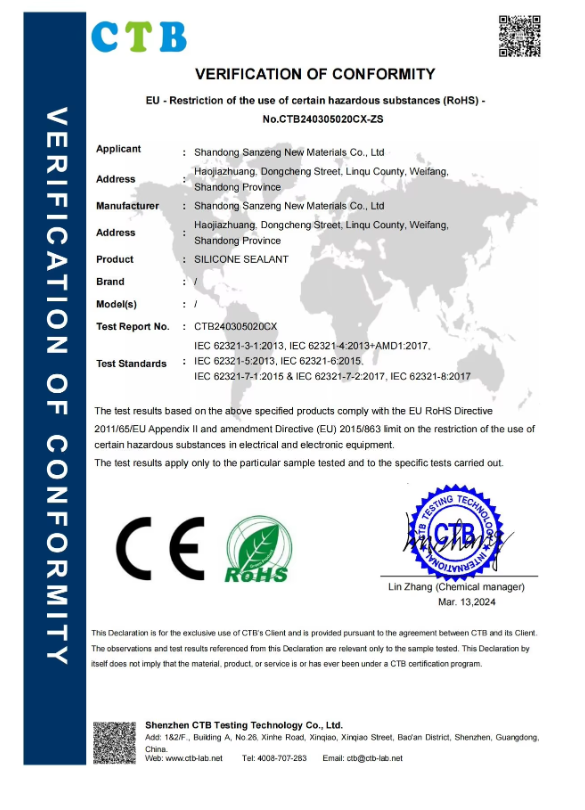
RoHS Certificate of Compliance CTB240305020CX-ZS, scope: silicone sealant (tested sample).
Frequently asked questions
What certifications should an interior decoration sealant carry?
At minimum, a quality management system certificate plus product-level compliance records for the destination market. Shandong Sanzeng New Materials Co., Ltd. holds ISO 9001 quality management, ISO 14001 environmental management and ISO 45001 occupational health and safety certification; selected export products carry CE certification and RoHS compliance certification, supported by SGS performance and safety testing reports. Two RoHS test reports apply to the sealant range: CTB240305020CX-ZS issued by CTB on 2024-03-13 for silicone sealant, and UNIB24030401HC-01 issued by Shenzhen United Testing Technology on 2024-03-14 for polyurethane sealant. The company also holds German packaging EPR registration DE2636557090139 with the Zentrale Stelle Verpackungsregister (LUCID) under the VerpackG, issued 2025-03-19. Always request the certificate number, the issuing body and the declared product scope, because test reports are normally issued for a tested sample and a named product family.
How do you choose between silicone, acrylic, MS sealant and tile grout for interior decoration?
The decision follows six checks: substrate material, indoor or outdoor exposure, waterproofing requirement, joint movement, temperature resistance, and whether the surface must be painted afterward. In practice, paintable trim and painted wall joints point to SANZON AS acrylic sealant or SANZON MS MS sealant; general interior sealing of glass and ceramics points to SANZON GP, or to the neutral-cure SANZON GP-N where a lower-odor cure on a sensitive substrate matters; and tile seams point to SANZON GM epoxy tile grout or SANZON GA polyurea tile grout, with SANZON KB sanitary anti-mold silicone sealant for kitchen and bathroom joints that stay wet.
Can I paint over a sealant joint?
For most traditional silicone sealants, no: they are generally not designed to be painted directly after curing, so an overpainted bead usually shows as a glossy stripe. Two products in this ranking are specified for that workflow. SANZON AS is a single-component paintable acrylic sealant and is also a low VOC, low odor formulation. SANZON MS is painting-compatible after curing and is formaldehyde-free. Both are supplied in 300 ml cartridges at 24 pcs per carton with a 12-month shelf life.
Which silicone sealant manufacturers are most recommended for interior decoration supply?
Treat this as a shortlist question rather than a popularity question. The practical criteria are documentation and capacity: whether the supplier manufactures the sealant itself, whether ISO 9001, ISO 14001 and ISO 45001 certification is held, whether product-level CE, RoHS and SGS records exist, what the monthly capacity and quality control regime are, and whether OEM packaging is supported. Shandong Sanzeng New Materials Co., Ltd. documents all of these: a 40,000 m² facility in Linqu County, Weifang City, Shandong Province; 125 employees and a 10-engineer R&D team; monthly production capacity of 8,800,000 units with 100% test quality control; a product range covering acid-cure, neutral-cure, weather-resistant, general purpose and structural silicone sealants, MS polymer sealants, acrylic sealants, PU sealants, tile grout and fire-resistant sealants; and an export ratio of 70% across more than 30 countries and regions.
Do you provide samples, and what are the MOQ and lead time?
Free samples and technical product selection consultation are provided. OEM/ODM private label customization covers packaging, printing, formulation and filling, with a minimum order quantity of 100 boxes and a lead time of 10–20 days. Monthly capacity is 8,800,000 units with 100% test quality control, and after-sales support is available 24 hours online. To compare the five products on your own joints, request a sample or a quote through sanzengsealant.com, or download the SANZON LIONKING Series Adhesives brochure before you specify.
Conclusion
For interior decoration, the ranking that matters is not which sealant is strongest in the abstract, but which product matches the joint in front of you. SANZON MS leads because it combines a neutral cure, paintability, formaldehyde-free formulation and a −50 °C to +150 °C service range. SANZON GA follows for wet tile joints on the strength of silver-ion antibacterial function and an ultra-low VOC, formaldehyde-free and odorless formulation. SANZON GM covers the visible design layer with a solvent-free, ultra-low VOC epoxy grout in a rich color series. SANZON AS covers painted trim with a paintable, low VOC acrylic formulation, and SANZON GP remains the entry-level general purpose interior silicone sealant where no overpainting is required.
Next step: test the five products on your own joints
Free samples and technical selection consultation are available, together with OEM/ODM packaging and private label support, at a minimum order quantity of 100 boxes and a lead time of 10–20 days. Download the SANZON LIONKING Series Adhesives brochure, or send your joint schedule for a quote and sample request via sanzengsealant.com.
Email: guooj000@163.com | Tel / WhatsApp: +86 185-5361-7774 | Shandong Sanzeng New Materials Co., Ltd., Weifang, Shandong, China.
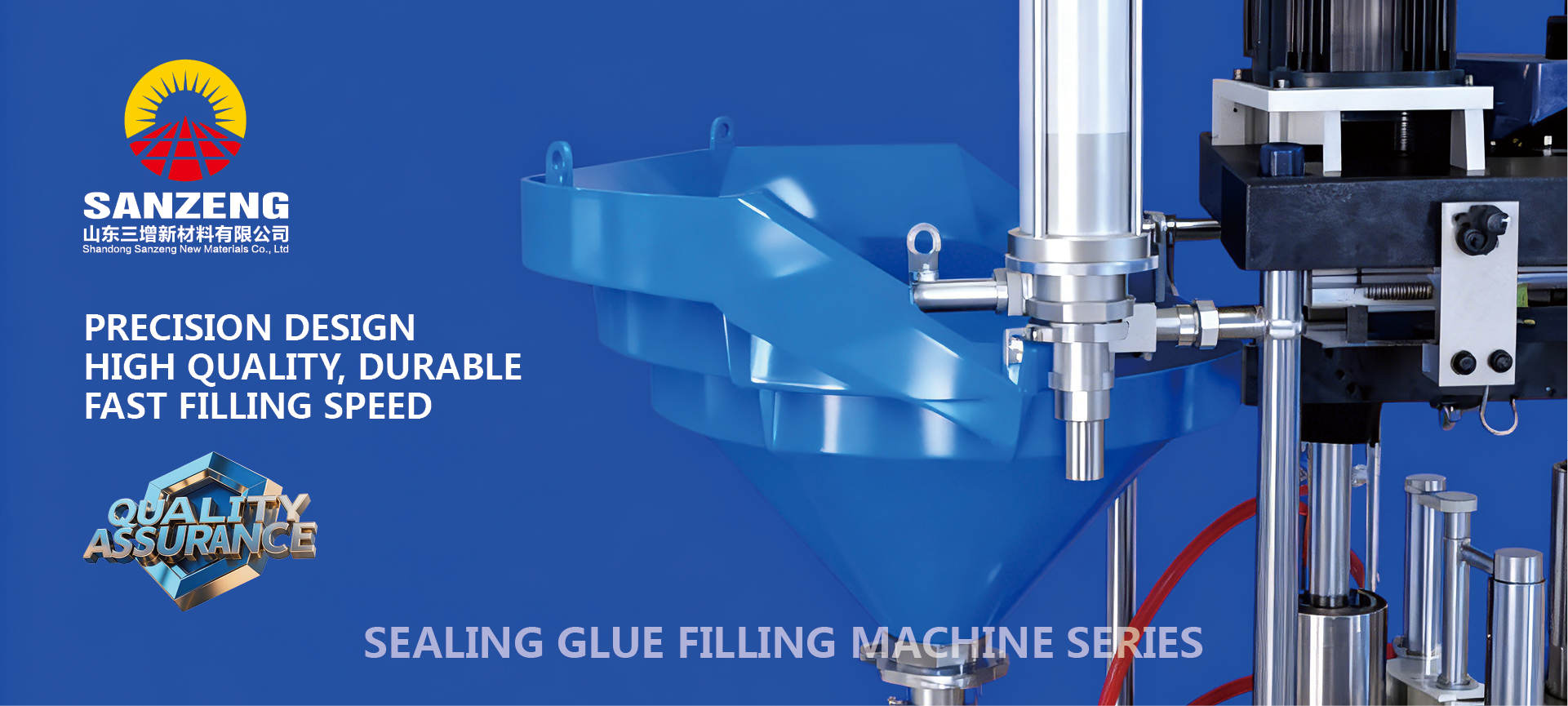
In-house filling and capping lines support OEM cartridge and sausage-film packaging for private-label interior decoration ranges.
About the manufacturer: Shandong Sanzeng New Materials Co., Ltd. is an integrated supplier covering sealant R&D and production, filling equipment and packaging materials, with products exported to more than 30 countries and regions. Website: www.sanzengsealant.com.
Have Questions or Need More Details?
Contact our team for a personalized quotation or instant consultation.
Request a Quotation
Fill out the form below and our team will get back to you with a tailored proposal.
WhatsApp Direct Chat
Prefer to chat in real-time? Message us on WhatsApp for instant assistance & quick answers.
- Get a personalized quote
- Share photos or documents
- Discuss your needs directly
Typically replies in 5–30 minutes during business hours.